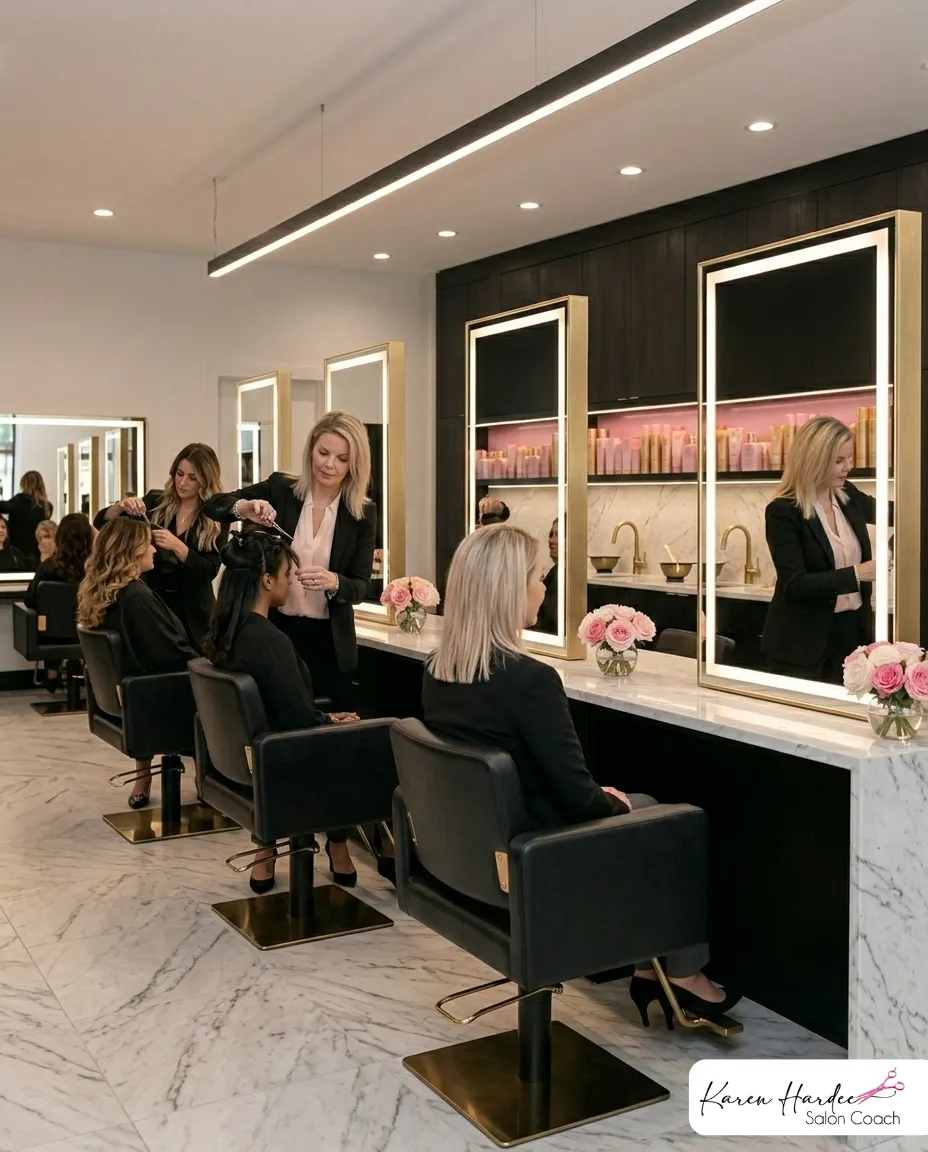
CEOs Don't Hope for Loyalty. They Design It: The Second Visit Mindset Shift Every Beauty Business Owner Needs
Most salon owners and hairdressers were trained to deliver beautiful work.
Very few were trained to design loyal clients.
You were taught how to perfect a color formula, create a flawless cut, or deliver an incredible guest experience in the chair.
But almost no one taught you how to think like the CEO responsible for client retention.
And that gap between delivering great services and intentionally designing client loyalty is where thousands of dollars in revenue quietly disappear from beauty businesses every single month.
Because the truth is this:
Great services create the first visit.
Systems create the second visit.
Without a designed client journey, even happy guests drift away.
Not because they didn’t love the experience.
But because no one created the path that brings them back.
And the moment you shift from hoping clients return to designing the conditions that make them return, everything in your business begins to change.
Quick Answer
Salon CEOs do not rely on hope to keep their clients.
They design businesses that make returning the obvious next step.
The mindset shift salon owners and hairdressers need is moving from hoping clients come back to leading a client journey in which the second visit feels natural, expected, and easy.
Loyalty is not accidental.
It is intentional.
Why Mindset Is the Missing Link in Salon Client Retention
Most retention problems are not operational at their root.
They are identity problems.
When a beauty professional believes their responsibility ends when the service ends, their systems reflect that belief perfectly.
Clients leave without a maintenance plan.
The next visit is not discussed.
Follow-up feels uncomfortable.
And over time, even satisfied clients quietly disappear.
But the moment you claim the CEO identity, your decisions begin to change.
You stop hoping clients return.
You begin designing the experience that brings them back.
You define the client journey.
You establish the team standard.
You lead the culture around retention.
You measure what matters.
Because systems follow leadership.
And leadership follows identity.
The Service Provider Mindset vs the CEO Mindset
Many beauty professionals unknowingly operate from what I call the service provider mindset.
Service providers focus on delivering a great appointment.
They assume that if the client loved their hair, they will naturally return.
But salon CEOs understand something different.
Even incredible services cannot create predictable loyalty on their own.
Service Provider Mindset:
• Focuses on the appointment
• Assumes satisfaction leads to loyalty
• Leaves the next visit open-ended
CEO Mindset:
• Designs the entire client journey
• Guides clients toward the next visit
• Measures retention intentionally
Service providers deliver services.
Salon CEOs design client journeys.
And the second visit is the most important moment in that journey.
The Leadership Mirror
Before going further, pause for a moment and look at your business honestly.
Not from the perspective of the stylist behind the chair.
But from the perspective of the CEO responsible for retention.
Ask yourself a few simple questions.
Do most of your clients leave without a clearly mapped next visit?
Do you rely on clients to remember to rebook, rather than guiding them to their next appointment?
Do you assume that if someone loved their service, they will naturally return?
If the honest answer to any of these questions is yes, the issue is not talent.
It is leadership.
Service providers focus on the appointment.
Salon CEOs focus on the entire client journey.
Service providers deliver great experiences in the moment.
Salon CEOs design systems that make returning the natural next step.
The moment you shift from asking:
“Will they come back?”
to asking:
“How have I designed the path that brings them back?”
Your business begins to change.
Because leaders do not wait for loyalty.
They design the conditions that create it.
How to Stop Feeling Like Follow-Up Is Pushy
One of the biggest mental barriers salon owners and hairdressers face is the belief that follow-up feels pushy.
But following up after a first visit is not selling.
It is serving.
When you check in within 24 hours and remind your client when their maintenance window opens, you are providing professional guidance.
You are extending the care beyond the appointment.
Think about other professionals.
A dermatologist schedules your follow-up before you leave.
A personal trainer maps your next sessions.
A nutritionist checks in after your first consultation.
None of them feel pushy.
They feel professional.
And so should you.
Here are the reframes that eliminate follow-up fear:
• What feels pushy to me often feels attentive to my client
• I am not asking them to spend money, I am helping them protect their investment
• Follow-up is the continuation of care, not a sales tactic
• The most caring thing I can do is make returning easy
When you lead from service instead of fear of rejection, follow-up becomes a natural extension of your expertise.
Leading Your Team to Prioritize Retention
Retention is rarely a team problem.
It is almost always a leadership signal.
If your team is not consistently guiding clients toward the next visit, the issue is usually clarity—not effort.
Strong leaders close that gap with three things.
Define the Standard
Every client leaves with a maintenance plan and a conversation about the next appointment.
This is not optional.
It is part of the client experience.
Model the Standard
If you are still behind the chair, demonstrate the process.
Let your team see how you naturally guide the next visit conversation.
Teams mirror behavior before they follow instructions.
Measure What Matters
Stop celebrating new clients alone.
Start tracking:
• rebooking rates
• second visit conversions
• retention milestones
What you measure signals what matters in your business.
The CEO Identity Reframe Toolkit
These are not affirmations.
They are leadership truths.
Use them to reset your thinking.
Hope is not a retention strategy. Design is.
Every client who leaves without a plan is a leadership decision.
The second visit is not the client’s responsibility to initiate; it is mine to make easy.
I am not being pushy. I am being the professional my clients hired.
Loyalty is the outcome of consistent, intentional care.
And most importantly:
Great services create the first visit.
Systems create the second visit.
The Ten-Minute Weekly CEO Retention Audit
Most salon owners spend more time planning social media posts than reviewing their retention systems.
But one ten-minute review each week can reveal exactly where revenue is leaking from your business.
Run this quick audit weekly.
Step 1 — Review New Clients
How many new clients visited your salon last week?
How many already have a second visit scheduled?
Step 2 — Identify the Gap
Which clients left without a next appointment?
Where did the breakdown happen?
During the service?
At checkout?
In follow-up?
Step 3 — Activate Recovery
Send a quick check-in message to any client who has not rebooked yet.
One message.
One booking link.
Done.
Step 4 — Assess Team Consistency
Is every team member guiding the conversation for the next visit?
If not, identify where the process is breaking down.
Step 5 — Reinforce Leadership
Remind your team:
“We design loyalty. We don’t wait for it.”
Step 6 — Improve One System
Each week identify one friction point in the client journey and remove it.
Over twelve weeks, you eliminate twelve barriers to retention.
The compounding impact of that is significant.
The Hard Truth Most Salon Owners Never Hear
Most salon owners do not have a client problem.
They have a leadership problem.
Not because they lack talent.
And not because they do not care about their clients.
But because they were trained to think like service providers instead of leaders.
Service providers focus on appointments.
Salon CEOs focus on systems that create predictable client behavior.
Service providers hope clients return.
Salon CEOs design experiences that make returning inevitable.
Two salons with the same level of talent can produce completely different results.
One operates appointment to appointment.
The other operates system-to-system.
The difference is not skill.
It is leadership.
The Leadership Decision
At the end of the day, retention is not determined by your talent.
It is determined by your leadership.
Service providers deliver great appointments.
Salon CEOs design client journeys.
One approach depends on hope.
The other builds predictable loyalty.
And the moment you decide which leader you will be, your business begins to change.
FAQ's Most Salon Owners are asking
Why do so many salon owners struggle with client retention even when they deliver exceptional work? Because retention requires a system, not just a skill. Delivering exceptional services earns admiration and first visits. A well-designed follow-up protocol, second visit plan, and rebooking system is what earns loyalty and long-term revenue. Most beauty professionals were trained extensively in technique, but rarely in client-journey architecture. The mindset shift from technician to CEO is where retention problems are actually solved.
How do I stop feeling like a follow-up is pushy or salesy?
Reframe the purpose entirely. Following up is not selling; it is serving. When you check in after a first visit and communicate the maintenance window, you provide professional guidance and extend the quality of care beyond the appointment. A medical professional does not feel pushy when scheduling your follow-up before you leave. Neither should you. What feels uncomfortable to you as the provider almost always feels attentive and professional to the client.
How long does it take to see a mindset shift produce real retention results?
The mindset shift is immediate — the moment you decide to lead like a CEO rather than operate like a technician, your decisions change. The measurable retention results typically emerge within 30 to 60 days of consistent implementation. Salon and beauty business owners who fully commit to the second-visit protocol, the 24-hour follow-up, and the weekly retention audit see compounding improvements that accelerate significantly between 60 and 90 days.
Does this mindset apply to independent beauty professionals as well as salon teams?
Absolutely and perhaps even more powerfully. If you are a solo suite owner, independent lash artist, nail technician, or medspa injector, you are the CEO by default. You are the owner, the operator, the experience designer, and the retention system all at once. Claiming that identity fully, rather than just operating as a solo service provider, is what separates independent beauty professionals who build thriving, sustainable businesses from those who work hard and still feel like they are starting over every month.
What is the most important first step for a salon owner who wants to shift to a CEO retention mindset?
Start with the weekly retention audit. Spend ten minutes this week reviewing how many of your recent new clients have a second visit scheduled. That number will tell you everything you need to know about where your system currently stands, and it will give you the first concrete action to take. You cannot improve what you do not measure. And you cannot lead what you do not see clearly.
Your Next Step to a Smarter Salon
Together, Salon Tech AI and The Chair & Beyond have created the first all-in-one ecosystem that merges cutting-edge automation with proven business mentorship, enabling you to grow faster, lead confidently, and finally achieve balance in your beauty business.
Hustle built this industry, but it can no longer be what sustains us, especially when we’re often our own worst boundary-breakers. So we built wellness into Salon Tech AI to Protect Your Peace and Purpose.
Most beauty pros don’t burn out because they’re doing it wrong. They burn out because they’re doing everything and carrying it alone. That’s why Salon Tech AI was built with something most software never considers: protection, not just for your calendar, but for you.
Smart Boundaries: Guards your time so “just one more” doesn’t steal your life.
Burnout Prevention: Systems built for sustainability, not hustle seasons.
Scheduling Protection: Limits that prevent overbooking and exhaustion.
Wellness Reminders: Gentle prompts to pause, breathe, hydrate, and reset.
Mental Clarity: Less chaos, less decision fatigue, more leadership space. Because this isn’t just about growth. It’s about protecting your mental and emotional health so you can show up for your calling and the people you love. A business that costs your peace is too expensive. Salon Tech AI was built to change that.



Hairdresser · Salon Owner · Salon Business Strategist · Top 200 Salon in North America · Founder, SalonTech AI
Feeling Stuck, Overwhelmed, or Burned Out in Your Salon Business?
Discover the simple systems and strategies top salon owners are using to attract more dream clients, keep them coming back, and finally create freedom without the burnout.
You don't need another late night of trying to do it all by hand. You need a proven way to get off the hamster wheel and build a business that runs smoothly-without running you into the ground. That's exactly what i'll show you inside my free live training:
You'll learn:
The #1 reason most salons lose clients (and how to fix it fast)
The simple retention system that keeps your books full without chasing
How to multiply income streams so you're not living client-to-client
The exact steps to create freedom in your business and life
(Seats are limited-don't miss the next live session!)


CEOs Don't Hope for Loyalty. They Design It: The Second Visit Mindset Shift Every Beauty Business Owner Needs
Most salon owners and hairdressers were trained to deliver beautiful work.
Very few were trained to design loyal clients.
You were taught how to perfect a color formula, create a flawless cut, or deliver an incredible guest experience in the chair.
But almost no one taught you how to think like the CEO responsible for client retention.
And that gap between delivering great services and intentionally designing client loyalty is where thousands of dollars in revenue quietly disappear from beauty businesses every single month.
Because the truth is this:
Great services create the first visit.
Systems create the second visit.
Without a designed client journey, even happy guests drift away.
Not because they didn’t love the experience.
But because no one created the path that brings them back.
And the moment you shift from hoping clients return to designing the conditions that make them return, everything in your business begins to change.
Quick Answer
Salon CEOs do not rely on hope to keep their clients.
They design businesses that make returning the obvious next step.
The mindset shift salon owners and hairdressers need is moving from hoping clients come back to leading a client journey in which the second visit feels natural, expected, and easy.
Loyalty is not accidental.
It is intentional.
Why Mindset Is the Missing Link in Salon Client Retention
Most retention problems are not operational at their root.
They are identity problems.
When a beauty professional believes their responsibility ends when the service ends, their systems reflect that belief perfectly.
Clients leave without a maintenance plan.
The next visit is not discussed.
Follow-up feels uncomfortable.
And over time, even satisfied clients quietly disappear.
But the moment you claim the CEO identity, your decisions begin to change.
You stop hoping clients return.
You begin designing the experience that brings them back.
You define the client journey.
You establish the team standard.
You lead the culture around retention.
You measure what matters.
Because systems follow leadership.
And leadership follows identity.
The Service Provider Mindset vs the CEO Mindset
Many beauty professionals unknowingly operate from what I call the service provider mindset.
Service providers focus on delivering a great appointment.
They assume that if the client loved their hair, they will naturally return.
But salon CEOs understand something different.
Even incredible services cannot create predictable loyalty on their own.
Service Provider Mindset:
• Focuses on the appointment
• Assumes satisfaction leads to loyalty
• Leaves the next visit open-ended
CEO Mindset:
• Designs the entire client journey
• Guides clients toward the next visit
• Measures retention intentionally
Service providers deliver services.
Salon CEOs design client journeys.
And the second visit is the most important moment in that journey.
The Leadership Mirror
Before going further, pause for a moment and look at your business honestly.
Not from the perspective of the stylist behind the chair.
But from the perspective of the CEO responsible for retention.
Ask yourself a few simple questions.
Do most of your clients leave without a clearly mapped next visit?
Do you rely on clients to remember to rebook, rather than guiding them to their next appointment?
Do you assume that if someone loved their service, they will naturally return?
If the honest answer to any of these questions is yes, the issue is not talent.
It is leadership.
Service providers focus on the appointment.
Salon CEOs focus on the entire client journey.
Service providers deliver great experiences in the moment.
Salon CEOs design systems that make returning the natural next step.
The moment you shift from asking:
“Will they come back?”
to asking:
“How have I designed the path that brings them back?”
Your business begins to change.
Because leaders do not wait for loyalty.
They design the conditions that create it.
How to Stop Feeling Like Follow-Up Is Pushy
One of the biggest mental barriers salon owners and hairdressers face is the belief that follow-up feels pushy.
But following up after a first visit is not selling.
It is serving.
When you check in within 24 hours and remind your client when their maintenance window opens, you are providing professional guidance.
You are extending the care beyond the appointment.
Think about other professionals.
A dermatologist schedules your follow-up before you leave.
A personal trainer maps your next sessions.
A nutritionist checks in after your first consultation.
None of them feel pushy.
They feel professional.
And so should you.
Here are the reframes that eliminate follow-up fear:
• What feels pushy to me often feels attentive to my client
• I am not asking them to spend money, I am helping them protect their investment
• Follow-up is the continuation of care, not a sales tactic
• The most caring thing I can do is make returning easy
When you lead from service instead of fear of rejection, follow-up becomes a natural extension of your expertise.
Leading Your Team to Prioritize Retention
Retention is rarely a team problem.
It is almost always a leadership signal.
If your team is not consistently guiding clients toward the next visit, the issue is usually clarity—not effort.
Strong leaders close that gap with three things.
Define the Standard
Every client leaves with a maintenance plan and a conversation about the next appointment.
This is not optional.
It is part of the client experience.
Model the Standard
If you are still behind the chair, demonstrate the process.
Let your team see how you naturally guide the next visit conversation.
Teams mirror behavior before they follow instructions.
Measure What Matters
Stop celebrating new clients alone.
Start tracking:
• rebooking rates
• second visit conversions
• retention milestones
What you measure signals what matters in your business.
The CEO Identity Reframe Toolkit
These are not affirmations.
They are leadership truths.
Use them to reset your thinking.
Hope is not a retention strategy. Design is.
Every client who leaves without a plan is a leadership decision.
The second visit is not the client’s responsibility to initiate; it is mine to make easy.
I am not being pushy. I am being the professional my clients hired.
Loyalty is the outcome of consistent, intentional care.
And most importantly:
Great services create the first visit.
Systems create the second visit.
The Ten-Minute Weekly CEO Retention Audit
Most salon owners spend more time planning social media posts than reviewing their retention systems.
But one ten-minute review each week can reveal exactly where revenue is leaking from your business.
Run this quick audit weekly.
Step 1 — Review New Clients
How many new clients visited your salon last week?
How many already have a second visit scheduled?
Step 2 — Identify the Gap
Which clients left without a next appointment?
Where did the breakdown happen?
During the service?
At checkout?
In follow-up?
Step 3 — Activate Recovery
Send a quick check-in message to any client who has not rebooked yet.
One message.
One booking link.
Done.
Step 4 — Assess Team Consistency
Is every team member guiding the conversation for the next visit?
If not, identify where the process is breaking down.
Step 5 — Reinforce Leadership
Remind your team:
“We design loyalty. We don’t wait for it.”
Step 6 — Improve One System
Each week identify one friction point in the client journey and remove it.
Over twelve weeks, you eliminate twelve barriers to retention.
The compounding impact of that is significant.
The Hard Truth Most Salon Owners Never Hear
Most salon owners do not have a client problem.
They have a leadership problem.
Not because they lack talent.
And not because they do not care about their clients.
But because they were trained to think like service providers instead of leaders.
Service providers focus on appointments.
Salon CEOs focus on systems that create predictable client behavior.
Service providers hope clients return.
Salon CEOs design experiences that make returning inevitable.
Two salons with the same level of talent can produce completely different results.
One operates appointment to appointment.
The other operates system-to-system.
The difference is not skill.
It is leadership.
The Leadership Decision
At the end of the day, retention is not determined by your talent.
It is determined by your leadership.
Service providers deliver great appointments.
Salon CEOs design client journeys.
One approach depends on hope.
The other builds predictable loyalty.
And the moment you decide which leader you will be, your business begins to change.
FAQ's Most Salon Owners are asking
Why do so many salon owners struggle with client retention even when they deliver exceptional work? Because retention requires a system, not just a skill. Delivering exceptional services earns admiration and first visits. A well-designed follow-up protocol, second visit plan, and rebooking system is what earns loyalty and long-term revenue. Most beauty professionals were trained extensively in technique, but rarely in client-journey architecture. The mindset shift from technician to CEO is where retention problems are actually solved.
How do I stop feeling like a follow-up is pushy or salesy?
Reframe the purpose entirely. Following up is not selling; it is serving. When you check in after a first visit and communicate the maintenance window, you provide professional guidance and extend the quality of care beyond the appointment. A medical professional does not feel pushy when scheduling your follow-up before you leave. Neither should you. What feels uncomfortable to you as the provider almost always feels attentive and professional to the client.
How long does it take to see a mindset shift produce real retention results?
The mindset shift is immediate — the moment you decide to lead like a CEO rather than operate like a technician, your decisions change. The measurable retention results typically emerge within 30 to 60 days of consistent implementation. Salon and beauty business owners who fully commit to the second-visit protocol, the 24-hour follow-up, and the weekly retention audit see compounding improvements that accelerate significantly between 60 and 90 days.
Does this mindset apply to independent beauty professionals as well as salon teams?
Absolutely and perhaps even more powerfully. If you are a solo suite owner, independent lash artist, nail technician, or medspa injector, you are the CEO by default. You are the owner, the operator, the experience designer, and the retention system all at once. Claiming that identity fully, rather than just operating as a solo service provider, is what separates independent beauty professionals who build thriving, sustainable businesses from those who work hard and still feel like they are starting over every month.
What is the most important first step for a salon owner who wants to shift to a CEO retention mindset?
Start with the weekly retention audit. Spend ten minutes this week reviewing how many of your recent new clients have a second visit scheduled. That number will tell you everything you need to know about where your system currently stands, and it will give you the first concrete action to take. You cannot improve what you do not measure. And you cannot lead what you do not see clearly.
Your Next Step to a Smarter Salon
Together, Salon Tech AI and The Chair & Beyond have created the first all-in-one ecosystem that merges cutting-edge automation with proven business mentorship, enabling you to grow faster, lead confidently, and finally achieve balance in your beauty business.
Hustle built this industry, but it can no longer be what sustains us, especially when we’re often our own worst boundary-breakers. So we built wellness into Salon Tech AI to Protect Your Peace and Purpose.
Most beauty pros don’t burn out because they’re doing it wrong. They burn out because they’re doing everything and carrying it alone. That’s why Salon Tech AI was built with something most software never considers: protection, not just for your calendar, but for you.
Smart Boundaries: Guards your time so “just one more” doesn’t steal your life.
Burnout Prevention: Systems built for sustainability, not hustle seasons.
Scheduling Protection: Limits that prevent overbooking and exhaustion.
Wellness Reminders: Gentle prompts to pause, breathe, hydrate, and reset.
Mental Clarity: Less chaos, less decision fatigue, more leadership space. Because this isn’t just about growth. It’s about protecting your mental and emotional health so you can show up for your calling and the people you love. A business that costs your peace is too expensive. Salon Tech AI was built to change that.
I fiercely believe that you can create the life you've dreamed of, the impact you were born to make, and build generational wealth, all through your beauty business.
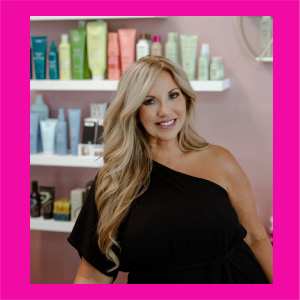

Karen Hardee is a powerhouse and a visionary for the Beauty Industry. With over three decades of experience, including 30 years as a salon owner & salon business coach– she's a game-changer. Karen's leadership has catapulted her salon to the Top 200 Fastest Growing Salons in North America, and she's ready to share her secrets with you. she's passionate about helping you fulfill your dreams and break through barriers. But Karen's not stopping there – her latest venture involves creating Salon Suite Buildings, a groundbreaking fusion of real estate and beauty, for unprecedented success and generational wealth.
Ready to take your business to 7+ figures?